


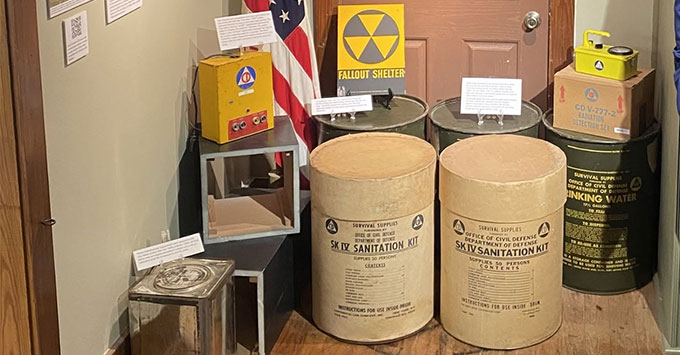
Elk City, OK – Long before Y2K, a crisis began 65 years ago this summer in Austria that resulted in a German wall and made Elk Citians stockpile food, water, and medicine to live through a nuclear war.
President Kennedy met with Soviet leader Nikita Khrushchev in Vienna, Austria, in June 1961 to discuss the increasingly tense situation in the German city of Berlin. Since the end of World War II in 1945, Berlin had been divided, with the Soviets controlling the city's east side and an American presence in the west.
The entire country of Germany was divided into eastern and western occupation zones at war's end, and Berlin was in the Soviet-controlled eastern zone, which, by summer 1961, had become the communist country East Germany.
More than 300,000 East Germans a year were fleeing East Germany and communism by crossing from Soviet-controlled East Berlin into free West Berlin. Khrushchev was desperate to stop the mass exodus.
At Vienna, he issued a six-month deadline to Kennedy for the Americans to leave Berlin, or the Soviet Union would sign a treaty with East Germany, ending occupation rights and granting the communist country and Soviet client state complete control of the city.
Khrushchev warned that Americans could either leave or risk nuclear war with the Soviet Union.
During this Berlin Crisis of 1961, Soviet Foreign Minister Andrey Gromyko threatened U.S. Ambassador Llewelyn Thompson, saying, “You know, you’ve got to recognize that if you allow Berlin to become the flash point for a war, we will incinerate New York City in 24 hours.”
Thompson replied that Soviet bombs would, no doubt, inflict damage on some American cities, "but you also know that the entire Soviet Union will become a rubble heap within 24 hours. It’s your choice of time frame; it will take a lot less than that.”
This crisis triggered a nuclear-war scare in the United States, including western Oklahoma.
The continued mass exodus from East Germany also triggered building the Berlin Wall, dividing that city and stopping free passage from its east to its west, on August 13, 1961.
The same month, the Kennedy administration asked Congress for money to stock public spaces around the nation with two-weeks' worth of food and sanitation and medical supplies as fallout shelters for Americans to live in and hopefully wait out the danger posed by atmospheric radiation after nuclear-bomb blasts.
Secretary of Defense Robert McNamara told Congress that, while "perhaps several tens of millions" of Americans could die in a nuclear attack, the administration hoped to save 50 million Americans, about a fourth of the nation's population, in public fallout shelters.
While people within the blast radius of a Soviet nuclear bomb’s explosion would die, the hope was that people beyond it could survive the lingering atmospheric radioactive fallout by living in at-home fallout shelters or public fallout shelters for two weeks until the air outside was safe again.
With the nuclear-weapons-assembly Pantex Plant in Amarillo to the west, nuclear-armed B-52 Bombers housed at Clinton-Sherman Air Force Base in Burns Flat, and 12 Atlas F intercontinental ballistic missile sites near Altus Air Force Base to the south, Elk City was uncomfortably close to presumed Soviet bombing targets.
Federal fallout-shelter signs with three yellow triangles in a black circle were placed on buildings that met the federal government's criteria. This let the public know where to seek shelter while away from home during an attack, and where they could live for two weeks while, hopefully, the atmosphere became livable.
Elk City's public federal fallout shelters included the basements of the First Baptist Church building, the Casa Grande Hotel, Community Hospital, and the building just south of the Post Office that housed both the Elk City Police Department and the Elk City Fire Department.
They were provided with radiation-detection equipment, water barrels to be filled locally, sanitation supplies, and medicines like aspirin, Eugenol, penicillin, and phenobarbital, plus bandages, gauze, and forceps.
Shelters here were also stocked with two weeks' worth of four foods provided by the Office of Civil Defense—survival biscuits, survival crackers, carbohydrate supplements, and bulgur wafers. They were packaged separately in sealed cans with an estimated shelf life of between 5 and 15 years.
They stayed in local fallout shelters much longer.
After the Cold War ended in 1991, the remaining civil-defense supplies from 30 years earlier went into storage at the Elk City Municipal Airport.
In November 2020, the storage was emptied. Some of the remaining Cold War-era civil-defense artifacts were donated to the Oklahoma Historical Society, and some were donated to Elk City's Old Town Museum, where they are on display.
Those artifacts evoke memories of crisis and fear 65 years ago when two superpowers threatened each other with possibly civilization-ending nuclear weapons and drove Americans, including Elk Citians, to stockpile supplies and prepare to survive what may have been unsurvivable.
Landry Brewer is Bernhardt Assistant Professor for Southwestern Oklahoma State University and teaches History and Political Science classes at SWOSU’s Sayre location. Brewer is also the author of “Cold War Oklahoma,” “Cold War Kansas,” and “Cold War Texas.”
Landry Brewer is Bernhardt Assistant Professor for Southwestern Oklahoma State University and teaches History and Political Science classes at SWOSU’s Sayre location. Brewer is also the author of “Cold War Oklahoma,” “Cold War Kansas,” and “Cold War Texas.”
Copyright 2026 Paragon Communications. All rights reserved. This material may not be published, broadcast, rewritten, or redistributed without permission.




.jpg)