


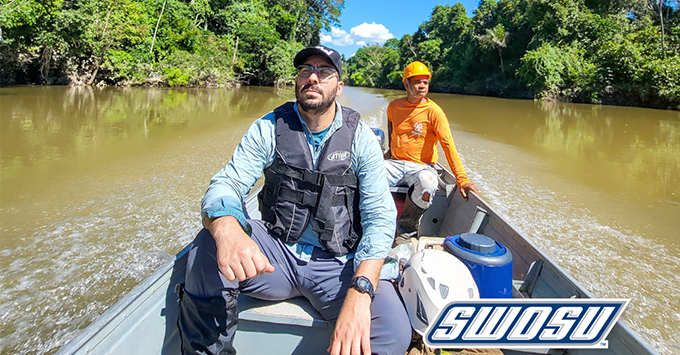
Weatherford, OK – Dr. Daniel da Rocha, assistant professor in the Department of Biological and Biomedical Sciences at Southwestern Oklahoma State University (SWOSU), led a pilot study this summer in the Brazilian Amazon to examine how wildlife responds to sustainable forest management. The project examines whether mammal communities can persist in forests that have been selectively logged rather than completely cleared. The work builds on Rocha’s long-term research into biodiversity conservation in tropical forests.
Rocha conducted the fieldwork at Fazenda Manoa, a 74,000-hectare private property located in Cujubim, Rondônia. Managed by Manoa Sustentável (Grupo Triângulo), the area is recognized as a leading example of sustainable forest management in the Amazon. Its environmental initiatives are supported by internationally recognized certifications that acknowledge best practices in forest stewardship, biodiversity conservation, and contributions to addressing climate change.
Researchers established 26 paired camera-trap stations throughout the study area. Each site had one camera on the forest floor and another high in the canopy. The team also deployed 13 video cameras to record animal behavior and interactions that traditional surveys may miss. In total, 65 cameras collected information about mammals living on the ground and in the trees. Professional tree climbers used specialized equipment to install cameras more than 82 feet above the forest floor.
Scientists affiliated with the Leibniz Institute for Zoo and Wildlife Research and the Max Planck Institute of Animal Behavior also participated in the fieldwork. They contributed expertise in canopy access, wildlife monitoring and tropical ecology. Researchers used the pilot to test and refine their methods for future work at managed forests. Manoa’s field team provided logistical and on-the-ground support throughout the survey. Rocha said the project was successful and produced sound data.
For more than a decade, Rocha has studied the effects of human activity on Amazonian wildlife. During his doctoral research, he examined how habitat fragmentation affected mammal communities across the Amazon’s “Arc of Deforestation,” one of the world’s most active deforestation frontiers. His findings documented the ecological consequences of converting forests into agricultural land.
“Much of my previous research focused on understanding the impacts of deforestation and forest fragmentation on wildlife,” Rocha said. “Now, we’re asking a different question: Can economic activities that keep the forest standing provide a viable alternative for both people and biodiversity?”
The researchers are now reviewing thousands of images and videos collected during the summer. Rocha emphasized that the analysis is still underway. “Preliminary data suggest that these sustainably managed forests continue to support a remarkably diverse community of mammals,” Rocha said. “While we still have much to learn from the dataset, the early findings indicate that well-managed logging forests may retain substantial wildlife diversity.”
“Dr. Rocha’s preliminary data reinforce what we have seen on the ground for decades: a responsibly managed forest is a standing, living forest. Independent research like this is essential to show that management and conservation go hand in hand,” said Murilo Granemann, CEO of Manoa Sustentável.
SWOSU supported the pilot through Hagin funds for Biology Department research and a Project Development Grant. The funding helped Rocha and his collaborators complete the fieldwork, refine their methods and prepare the project for its next phase. Building on the success of the pilot study, the team is now pursuing research funding to launch a larger-scale survey across managed forests.
The findings could help forest managers, conservation organizations and policymakers evaluate sustainable forestry as an alternative to land uses that require complete forest clearing. The project is the first step in a broader effort to assess wildlife responses to sustainable logging across the Amazon. Rocha and his colleagues plan to survey additional managed forest areas next summer. Comparing results across multiple locations will help the team draw stronger conclusions about the role sustainable forestry may have in conserving Amazonian biodiversity.
To learn more about the Department of Biological and Biomedical Sciences, visit https://www.swosu.edu/biological-sciences/index.php.
Copyright 2026 Paragon Communications. All rights reserved. This material may not be published, broadcast, rewritten, or redistributed without permission.



.jpg)