


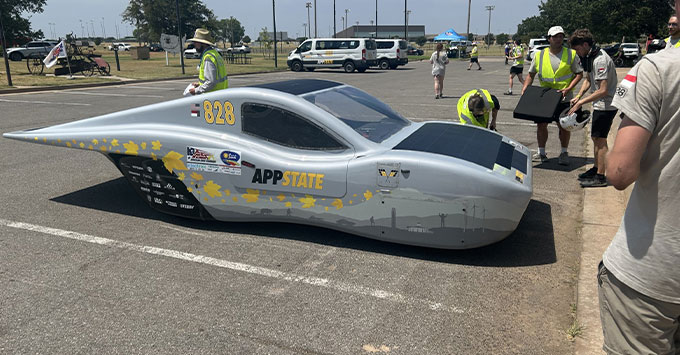
Elk City, OK – The future of transportation rolled down the Mother Road Friday as the Electrek American Solar Challenge made an official Stage Stop at the National Route 66 Museum, bringing student-built solar race cars from around the world to western Oklahoma.
The stop marked the end of Stage 3 of the more than 1,500 mile competition, which began in Minneapolis, Minnesota, and concludes Saturday in Amarillo, Texas. Teams arrived throughout the day before preparing their vehicles for the final sprint to the finish line.
"My name is Gail Lueck and my title is Event Director of the Electric American Solar Challenge," Lueck said. "Today we have a stage point here in Elk City, Oklahoma. This is the end of stage three for their event, and they'll be starting here tomorrow morning for the one-day sprint to Amarillo, Texas."
The event is especially fitting for Elk City, as 2026 marks the 100th anniversary of Route 66. The National Route 66 Museum served as an official Route 66 Centennial Project site, giving visitors the chance to see cutting-edge solar technology alongside one of America's most historic highways.
The sleek, low-profile vehicles turned heads as they arrived, looking more like spacecraft than traditional automobiles. But behind each solar car is years of engineering, testing, and teamwork.
"For many of these teams, it's a two-year design-build process to get the car designed, get all the parts procured and made, put the whole car together, and hopefully leave some time for testing before coming out to the event," Lueck explained.
Before ever reaching the open road, each team faced a demanding qualification process at Brainerd International Raceway in Minnesota. Vehicles underwent extensive mechanical and electrical inspections, followed by dynamic testing and a three-day endurance event on a 3.1 mile race course.
The competition itself is designed to push both the cars and the students to their limits.
"We had 39 colleges and universities arrive in Brainerd with solar cars," Lueck said. "About 30 made it onto the track, and 19 qualified to leave Minneapolis. We've had teams drop out with intense heat, rainstorms, and technical issues. There are 14 solar cars still on the road."
The remaining competitors represent universities across the United States, Canada, Belgium, and the Netherlands.
Lueck said seeing the field shrink during the event is expected.
"This is really the proving ground for what they designed on paper and then built," she said. "This is putting it to the real-world test, covering more than 1,500 miles from Minneapolis to Amarillo."
Unlike many cross-country races, the American Solar Challenge intentionally avoids interstate highways whenever possible. Instead, organizers route competitors along scenic byways and historic roads.
"We've been taking Route 66 through Illinois, Missouri, Kansas, now Oklahoma, and tomorrow Texas to finish in Amarillo," Lueck said.
The route changes every two years, allowing different communities to host the event and giving students new challenges each time.
"It provides a new challenge for the teams and moves it around the country so more communities like Elk City get the opportunity to see the solar cars, meet the drivers, and take a peek inside the cars during evening charging," she said.
Residents had the opportunity Friday evening to view the vehicles during charging at the National Route 66 Museum before the teams depart at 9 a.m. Saturday for the final leg to Amarillo.
The Electrek American Solar Challenge is held every two years and showcases the innovation, engineering, and endurance of collegiate teams as they test solar-powered vehicles under real-world conditions across North America.
Copyright 2026 Paragon Communications. All rights reserved. This material may not be published, broadcast, rewritten, or redistributed without permission.

.jpg)


.jpg)